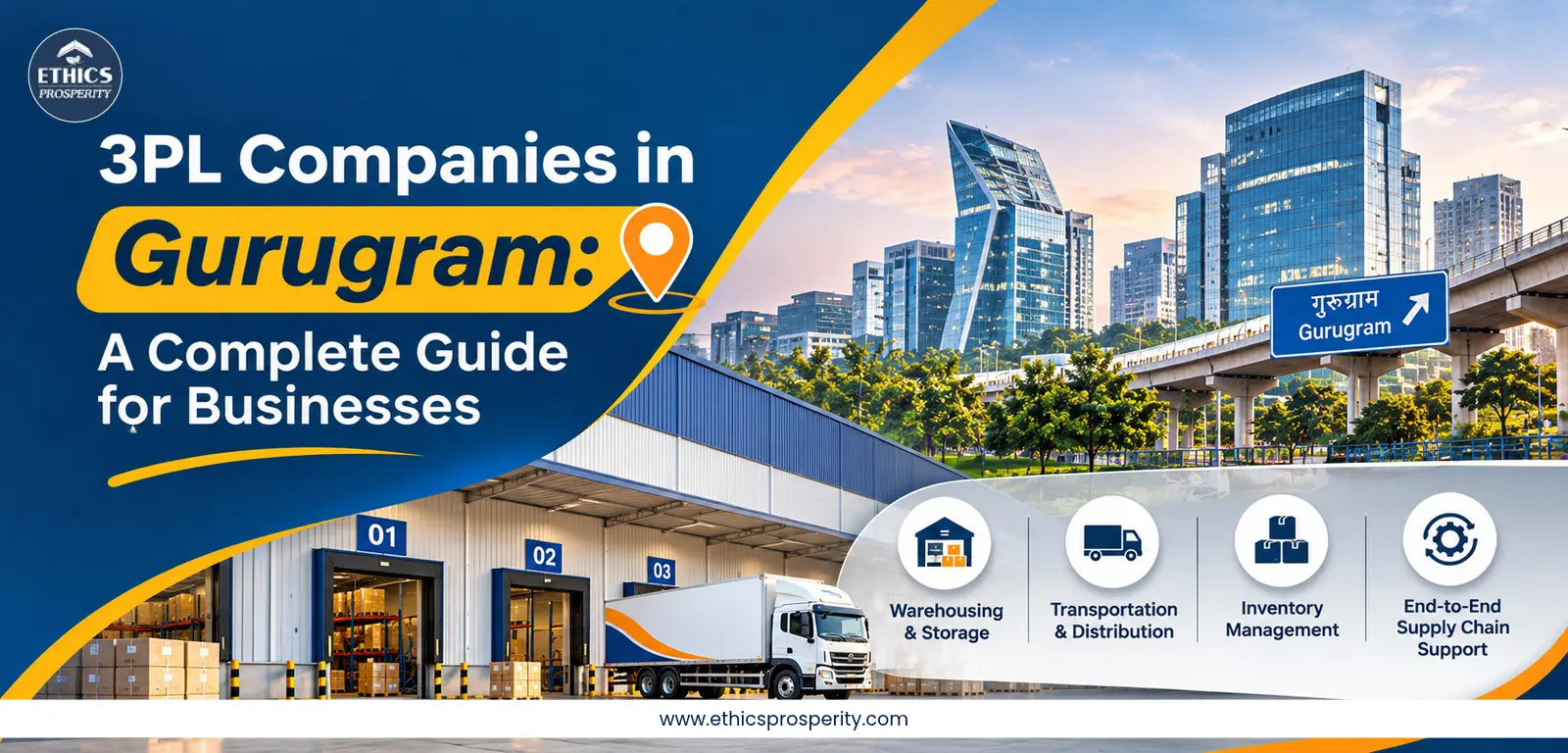
Gurugram has developed into an important business and logistics centre within the Delhi-NCR region. Its proximity to Delhi, access to major road corridors, industrial clusters and large consumer markets make it a strategic location for businesses managing regional and national distribution.
As companies expand their operations, managing storage, inventory, transportation and order fulfilment internally can become increasingly complex. Businesses must coordinate warehouse capacity, shipment schedules, delivery partners, returns and inventory accuracy while controlling operating costs.
This is where third-party logistics (3PL) partnerships become valuable. Instead of investing independently in every logistics function, businesses can outsource selected operations to an experienced service provider.
However, selecting a logistics partner requires more than comparing prices. The right provider should understand the company's product category, order volumes, distribution requirements, technology needs and service expectations.
This guide explores ten logistics providers included in this shortlist and explains what businesses should evaluate before choosing a 3PL partner in Gurugram.
What Are 3PL Companies and What Services Do They Offer?
A third-party logistics company manages selected logistics activities on behalf of another business. Depending on the contract, its responsibilities may include warehousing, inventory handling, transportation, order processing, distribution and returns management.
For manufacturers, retailers, e-commerce brands and distributors, outsourcing these activities can reduce the operational burden of managing multiple logistics vendors and facilities.
Common services offered by 3PL providers include:
-
Warehousing and storage: Receiving, storing and managing goods in shared or dedicated facilities.
-
Inventory management: Monitoring stock levels, recording movements and supporting stock reconciliation.
-
Order fulfilment: Picking, packing, labelling and dispatching customer orders.
-
Transportation: Coordinating full truckload (FTL), part truckload (PTL) and other shipment movements.
-
Distribution: Moving products from warehouses to distributors, retailers, business customers or end consumers.
-
Reverse logistics: Managing returns, product inspection and movement of returned inventory.
-
Technology integration: Providing visibility through warehouse, transport and order management systems.
For a business, the value of a 3PL partnership is not simply outsourced labour or storage space. It is the ability to establish more consistent processes, improve operational visibility and scale logistics capacity as demand changes.
List of Top 10 3PL Companies in Gurugram
The following companies are included in this practical shortlist based on the outline and their relevance to the Indian logistics and supply chain sector. The list is not an independently audited ranking by revenue, market share or service quality. Businesses should confirm current local operating locations, service availability and commercial terms directly with each provider.
1. Ethics Prosperity
Ethics Prosperity provides integrated logistics and warehousing solutions for businesses with varied distribution requirements. Its published service portfolio includes multi-client and dedicated warehousing, inventory management, order fulfilment, reverse logistics and customised warehouse operations.
The company also describes technology-led operations supported by warehouse and transport management capabilities. These services are relevant to organisations looking to coordinate storage, inventory handling and distribution through an integrated operating model.
Businesses evaluating a potential partnership should discuss product handling requirements, warehouse locations, implementation timelines, technology integration and service-level expectations before finalising a solution.
Suitable evaluation areas: Contract warehousing, fulfilment, inventory operations and integrated distribution requirements.
2. Safexpress
Safexpress is an established Indian logistics provider with services across express distribution, transportation and supply chain operations.
Businesses assessing Safexpress can examine its network coverage, shipment handling processes, delivery schedules and suitability for their distribution profile. Companies with regular movement of goods across multiple Indian markets should evaluate how the provider's network aligns with their origin and destination requirements.
Suitable evaluation areas: Express distribution, transportation and multi-location logistics requirements.
3. Transport Corporation of India (TCI)
Transport Corporation of India is a diversified logistics and supply chain group with operations across transportation, freight movement and integrated logistics.
For manufacturers, distributors and large businesses, the important evaluation points include transportation capacity, route coverage, shipment consolidation, warehouse support and coordination between different logistics activities.
Businesses should assess the specific TCI business division and service offering relevant to their contract rather than assuming every service is included in a single arrangement.
Suitable evaluation areas: Transportation, freight movement, distribution and integrated logistics.
4. Delhivery
Delhivery operates in the Indian logistics and parcel delivery sector, with services covering express parcel transportation, freight and supply chain operations.
Its logistics network can be relevant to businesses managing e-commerce shipments, customer deliveries and wider distribution requirements. Organisations should evaluate serviceability by PIN code, shipment volumes, delivery commitments, returns handling and technology integration.
Suitable evaluation areas: Parcel distribution, e-commerce shipments, freight and delivery network requirements.
5. Ecom Express
Ecom Express has been associated with technology-enabled e-commerce logistics and express delivery services in India. Its inclusion in this list reflects the outline, but its current business structure must be understood in the context of its acquisition by Delhivery.
Businesses considering this name should verify the current service structure, contracting entity, available facilities and operational arrangements directly with Delhivery before treating Ecom Express as a separate procurement option.
Suitable evaluation areas: E-commerce logistics requirements, subject to confirmation of current service availability and contracting arrangements.
6. Prozo
Prozo provides third-party warehousing, fulfilment and logistics services for businesses operating across online and offline sales channels.
Its published Gurugram warehouse information describes facilities in the Farukhnagar area and services covering storage, inventory handling, order fulfilment and distribution. Its offering also includes support for multi-channel fulfilment and technology integration.
Businesses with changing inventory levels or multiple sales channels can assess its shared, dedicated and managed warehousing options against their operating requirements.
Suitable evaluation areas: E-commerce fulfilment, multi-channel distribution and flexible warehousing.
7. AWL India
AWL India operates in the logistics and supply chain sector, with business offerings associated with warehousing, transportation and distribution.
For organisations considering AWL India, the evaluation should focus on the exact service scope available for their industry and geography. This includes warehouse infrastructure, handling processes, inventory reporting, transport arrangements and the ability to manage peak-period volumes.
A detailed operational discussion is important before comparing its proposal with other providers.
Suitable evaluation areas: Warehousing, transportation and distribution requirements, subject to confirmation of the proposed service scope.
8. Mahindra Logistics
Mahindra Logistics is an established Indian logistics provider offering services across supply chain management, contract logistics and transportation.
Its broader service portfolio makes it relevant for businesses evaluating outsourced logistics operations, particularly where warehouse processes and transportation need to work together.
Companies should examine the proposed operating model, warehouse network, technology capabilities, implementation approach and experience with similar product categories.
Suitable evaluation areas: Contract logistics, transportation and integrated distribution operations.
9. Varuna Integrated Logistics
Varuna Integrated Logistics operates in the Indian logistics sector, with services associated with transportation, warehousing and distribution.
For businesses with recurring B2B movement requirements, the key considerations include route planning, fleet availability, shipment visibility, delivery coordination and warehouse integration.
Companies should also assess the provider's ability to manage different shipment sizes and delivery frequencies without compromising agreed service levels.
Suitable evaluation areas: B2B transportation, warehousing and distribution coordination.
10. CJ Darcl Logistics
CJ Darcl Logistics provides logistics services across transportation, freight movement, warehousing and related supply chain activities.
Businesses with complex movement requirements can evaluate its road, rail and multimodal capabilities alongside warehouse and distribution support. The appropriate service combination will depend on the product category, shipment characteristics, delivery destinations and required transit timelines.
Before signing a contract, companies should clarify responsibility for documentation, cargo handling, transit visibility, insurance and exception management.
Suitable evaluation areas: Freight movement, multimodal transportation, warehousing and distribution.
How to Choose the Right 3PL Company in Gurugram
A logistics provider should be selected according to the operating requirements of the business, not simply its brand recognition or quoted warehouse rate. The following checks can help procurement, operations and supply chain teams make a more informed decision.
Evaluate Your Warehousing and Distribution Requirements
Start by identifying the products you handle, average inventory levels, SKU count, order frequency and destination markets. A business supplying retailers may need pallet storage and scheduled dispatches, while an e-commerce brand may require piece-level picking, packing and returns processing.
Also assess the Factors affecting warehouse location. Proximity to customers, suppliers, highways, labour availability and transport access can influence delivery time and total logistics cost.
A practical Warehouse location strategy should consider both current demand and future distribution requirements. A facility that appears economical on rent may increase transportation costs if it is poorly positioned relative to major customers.
Check Technology and Inventory Visibility
Technology is important when multiple teams, facilities and sales channels depend on accurate inventory information.
Ask providers about their warehouse systems, order integration, barcode scanning, stock reconciliation, reporting frequency and exception alerts. Understand how inventory discrepancies, damaged goods, delayed orders and returns are recorded and resolved.
Effective Warehouse Management should support accurate stock records and reliable operational decisions, not just provide a dashboard.
Review Transportation Network and Delivery Performance
Check whether the provider can serve your key delivery locations and manage the required shipment volumes. Ask for performance data relevant to your routes, such as on-time delivery, order fulfilment accuracy, transit exceptions and proof-of-delivery availability.
For businesses comparing Logistics companies in Gurgaon, it is important to distinguish between a corporate office, a local warehouse and an operational distribution network. These are not interchangeable.
Compare Pricing, SLAs and Scalability
Compare the complete commercial proposal rather than only the storage rate. Ask for a clear breakdown of receiving, storage, picking, packing, dispatch, transportation, returns, technology and additional handling charges.
Review the service-level agreement (SLA) carefully. It should define performance measures, reporting frequency, escalation procedures, liability, billing rules and remedies for service failures.
A well-designed 3PL warehousing services arrangement should also account for seasonal demand, new product launches and changes in order volumes.
Businesses should evaluate Third-party logistics providers against the same operational checklist to make the comparison fair. This is particularly important when comparing E-commerce fulfilment companies with providers focused mainly on bulk distribution.
For manufacturers and distributors, B2B logistics services may require scheduled dispatches, pallet-level handling, delivery appointments and proof of delivery. The provider should demonstrate how these processes will work in practice.
A reliable partner should be able to explain how its Warehousing and Distribution Service will fit into the wider business network. This is more useful than a broad promise of nationwide coverage.
When reviewing warehousing companies in India, businesses should also assess the quality of facility management, safety procedures, statutory compliance and business continuity arrangements. Similarly, supply chain companies should be compared on their ability to coordinate multiple operational functions, not only on individual service rates.
The wider objective of Supply chain management is to maintain a dependable flow of products and information while balancing cost, speed and service quality. A partner offering End-to-end supply chain solutions may be appropriate where a business wants integrated responsibility across several logistics functions.
Finally, Warehouse site selection in India should be based on measurable business requirements, including customer geography, supplier locations, transport connectivity, labour and long-term expansion plans.
Conclusion
Choosing the right 3PL partner in Gurugram can influence inventory availability, delivery performance, customer experience and overall logistics costs. Businesses should therefore evaluate providers through operational capability, technology, network suitability, transparent pricing and clearly defined service commitments.
The ten companies in this guide provide a starting point for further evaluation, but the best choice will depend on each organisation's product category, shipment profile, distribution geography and growth plans.
For businesses seeking warehousing, fulfilment and integrated distribution support, Ethics Prosperity can be considered as one option for a detailed discussion around operational requirements and suitable logistics solutions. A structured assessment of business needs and service expectations will help establish a partnership that supports long-term supply chain performance.