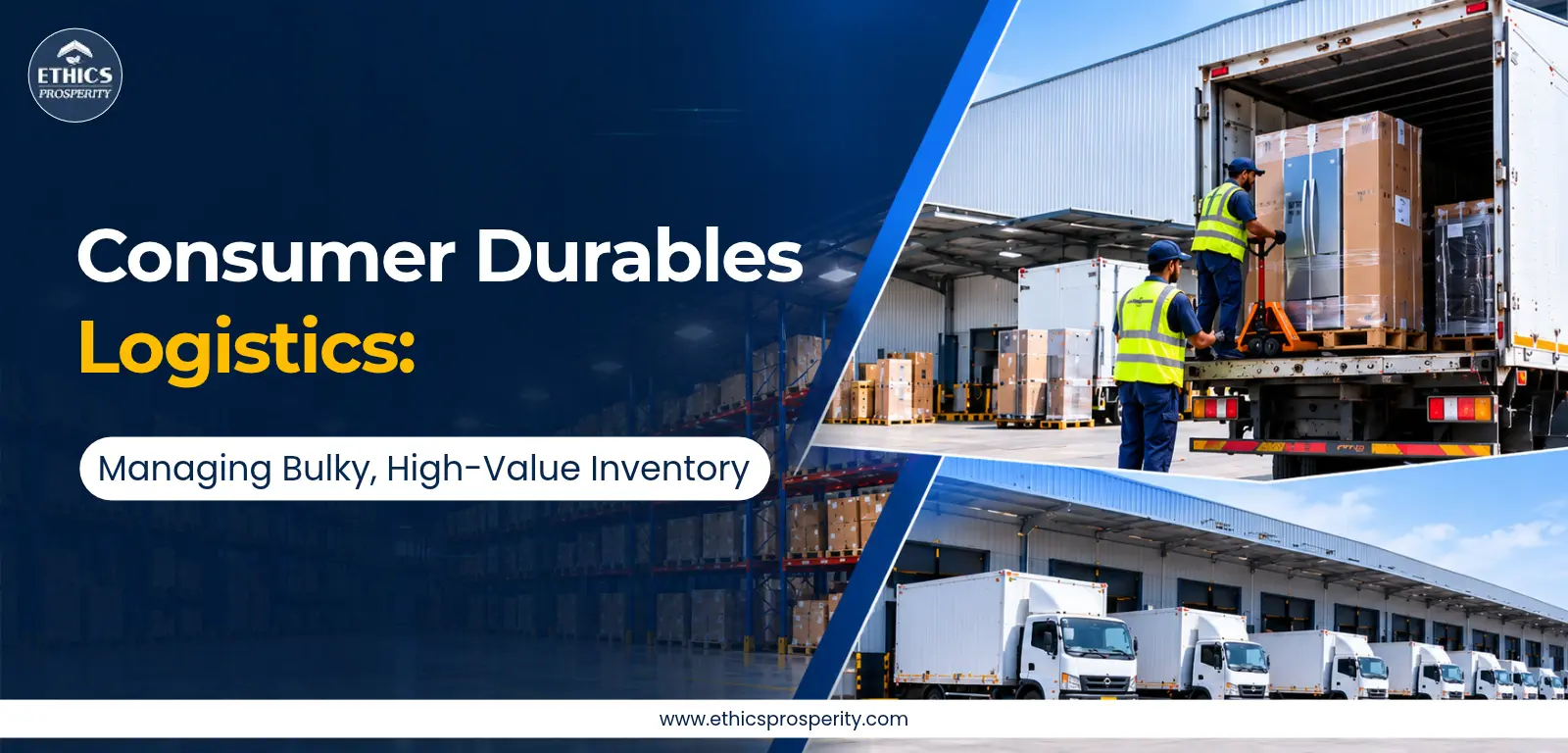
Consumer durables such as refrigerators, washing machines, televisions, air conditioners and kitchen appliances require more than routine storage and transportation. Their size, weight, packaging requirements and product value create operational challenges at every stage, from inbound receiving to final delivery.
For manufacturers, distributors, retailers and ecommerce businesses, Consumer Durables Logistics directly affects product availability, delivery reliability, damage-related costs and customer experience. A product may be available in the warehouse but still miss its delivery commitment because of inaccurate inventory records, unsuitable vehicle allocation or poor coordination between dispatch and installation teams.
Effective supply chain management for this category therefore requires a connected operating model that balances inventory availability, safe handling, transportation capacity and cost control.
The objective is not simply to move products faster. It is to deliver the right product, in saleable condition, to the right location, within the committed time and at a sustainable operating cost.
What Is Consumer Durables Logistics?
Consumer durables logistics covers the planning, storage, movement, tracking and return of long-life household and electronic products. It includes inbound transportation, warehouse operations, order processing, distribution, delivery coordination and reverse logistics.
An effective end-to-end supply chain connects manufacturers, regional distribution centres, warehouses, retailers, ecommerce fulfilment locations and customers through shared inventory information and clearly defined operating responsibilities.
For example, a distributor supplying refrigerators to multiple retail outlets needs to know which models are available at each facility, which units are allocated to customer orders, and whether vehicles can safely accommodate the planned loads. Without this visibility, businesses may experience stockouts in one location while excess inventory remains elsewhere.
For decision-makers asking what is logistics, the practical answer is the coordinated management of goods, information and related activities so products reach their intended destinations efficiently, safely and reliably.
Key Challenges in Managing Bulky, High-Value Inventory
Product damage and handling risks
Large appliances and electronic products can be damaged by impact, vibration, incorrect stacking, moisture or unsuitable handling equipment. Damage may occur even when the outer packaging appears intact.
The risk increases when products are repeatedly moved between storage zones, cross-docked without suitable protection or loaded without considering their dimensions and weight distribution.
Businesses should establish product-specific handling instructions, inspect packaging at receiving, document visible damage and use appropriate handling equipment. High-value items may also require serial-number capture and documented custody transfers.
Inventory visibility and storage constraints
Bulky products consume considerable floor and rack space. Different models, dimensions and demand patterns make warehouse slotting more complex than storing uniform cartons.
Poor location planning can increase travel time, obstruct movement and make frequently ordered products difficult to access. Inaccurate stock records may also lead to incorrect customer commitments.
Delivery coordination and cost control
Delivering a large appliance often involves more than reaching an address. The vehicle must accommodate the product safely, the customer must be available, and the delivery location must be accessible. Some orders may also require installation, removal of old equipment or delivery to a specific floor.
Failed delivery attempts create additional handling, transportation and customer-service costs. These costs should be measured rather than treated as unavoidable exceptions.
Best Practices for Consumer Durables Warehousing
A well-managed warehouse protects products while supporting accurate picking, efficient dispatch and predictable order fulfilment.
Slotting, storage and product protection
Start by classifying products according to dimensions, weight, handling requirements, value, order frequency and storage compatibility. Fast-moving products should be positioned to reduce unnecessary travel, while heavy products must be stored in locations and systems designed for their loads.
Businesses evaluating warehouse storage solutions should assess clear height, floor loading, aisle width, equipment compatibility, product dimensions and safe stacking limits before selecting a storage configuration. A solution that maximises nominal capacity may still be inefficient if it slows picking or increases damage risk.
For logistics and warehouse operations, standard operating procedures should define receiving checks, location assignment, replenishment, picking, packing, staging and dispatch verification. Staff should know which products can be stacked, which require upright handling and which need additional protective packaging.
Stock accuracy and dispatch readiness
Use barcode scanning or another reliable identification process to match each product with its SKU, model and serial number where applicable. Record receipts, transfers, allocations, dispatches and returns promptly.
Before dispatch, verify the product against the order, inspect packaging, confirm accessories and documentation, and ensure that the delivery route and vehicle are suitable. A final scan or checklist can prevent incorrect-model deliveries and reduce avoidable returns.
When comparing the top 10 warehousing companies in Gurugram, procurement teams should assess more than price and location. Relevant criteria include experience handling bulky goods, inventory accuracy, damage-control procedures, systems integration, peak-period capacity and the quality of operational reporting.
Safe Transportation and Last-Mile Delivery
Transportation planning should match the vehicle to the shipment, not simply allocate whatever capacity is available. Product dimensions, gross weight, load distribution, access restrictions, route conditions and delivery commitments all influence vehicle selection.
Vehicle selection and load security
Use suitable vehicles, restraints, protective materials and loading sequences to reduce movement during transit. Heavy items should be secured appropriately, fragile products should receive suitable protection, and loading plans should avoid placing unsafe pressure on packaging.
At dispatch, record shipment details and any pre-existing packaging damage. At delivery, capture proof of delivery and document exceptions immediately. Photographs and customer acknowledgements can help resolve disputes when supported by a clear process.
Delivery appointments and service coordination
Coordinate customer availability, delivery windows, vehicle access and installation requirements before dispatch. For business-to-business deliveries, receiving hours, unloading facilities and site safety rules should also be confirmed.
When assessing last mile delivery companies in India, businesses should evaluate delivery success rates, damage frequency, appointment adherence, geographic coverage, exception handling and the ability to support large or heavy products—not just the lowest per-delivery rate.
Likewise, organisations comparing logistics companies in India should examine how well each provider integrates with warehouse operations, provides shipment visibility, handles claims and manages seasonal volume increases.
Technology's Role in Inventory Control
Technology is valuable when it improves operational decisions and reduces avoidable errors. A warehouse management system (WMS) can support location control, stock movements, picking, replenishment and dispatch verification. Transport management tools can assist with route planning, vehicle utilisation and delivery tracking.
AI in logistics can support demand forecasting, exception identification and route or capacity planning when the underlying data is reliable. However, forecasts should be reviewed against promotions, regional demand, seasonality, stock availability and supplier lead times. Automated recommendations cannot compensate for inaccurate inventory records or poorly defined operating procedures.
For a consumer durables business, technology should answer practical questions:
-
Which models are available and saleable at each location?
-
Which orders are at risk of missing their promised delivery date?
-
Where are damage, failed delivery or inventory discrepancies increasing?
-
Which routes or facilities are generating avoidable costs?
The aim is actionable visibility—not simply collecting more data. Start with accurate master data, standardised workflows and clear exception ownership before expanding automation.
Reverse Logistics and Returns Management
Returns are particularly important for high-value products because a returned unit may need inspection, testing, repackaging, repair or warranty assessment before it can be resold.
Establish a defined process for return authorisation, collection, condition assessment and disposition. Each unit should be classified according to its condition and next step: resale, refurbishment, repair, supplier return, warranty processing or authorised disposal.
Record the reason for every return, such as transit damage, wrong product, installation issue, manufacturing defect or customer cancellation. Analysing these reasons helps businesses distinguish warehouse problems from transportation failures, product-quality issues and inaccurate order information.
A controlled reverse-logistics process shortens the time products remain unaccounted for and helps recover value without compromising product quality or customer trust.
KPIs to Measure Logistics Performance
Performance should be reviewed across service, inventory, quality and cost. The following measures help managers identify where corrective action is needed.
|
KPI |
What it measures |
|
On-time, in-full (OTIF) |
Orders delivered within the committed time with the correct quantity |
|
Inventory accuracy |
Agreement between recorded stock and physical stock |
|
Damage rate |
Percentage of handled or shipped units damaged, using a consistent denominator |
|
First-attempt delivery success |
Deliveries completed successfully on the initial attempt |
|
Order cycle time |
Time from order release to delivery or another defined endpoint |
|
Return rate by reason |
Returns segmented by damage, defect, cancellation and other causes |
|
Logistics cost per order |
Relevant logistics expenditure divided by orders handled |
Set baselines before introducing improvement targets. Review results by product category, facility, carrier, route and delivery type where data permits. A low average damage rate, for instance, can conceal recurring problems with one product model or one transport lane.
The most useful KPI is one that leads to a clear action, accountable owner and follow-up review.
Conclusion
Managing bulky, high-value products requires disciplined coordination across warehousing, inventory control, transportation, delivery and returns. Standardised handling procedures, accurate stock visibility, suitable vehicles, documented handovers and meaningful performance measures can help businesses reduce damage, improve delivery reliability and control operating costs.
The right operating model will depend on product mix, network design, order volumes and service commitments. Ethics Prosperity can be considered by businesses evaluating supply chain and warehousing support, with the final choice guided by service requirements, operational capabilities and measurable performance.