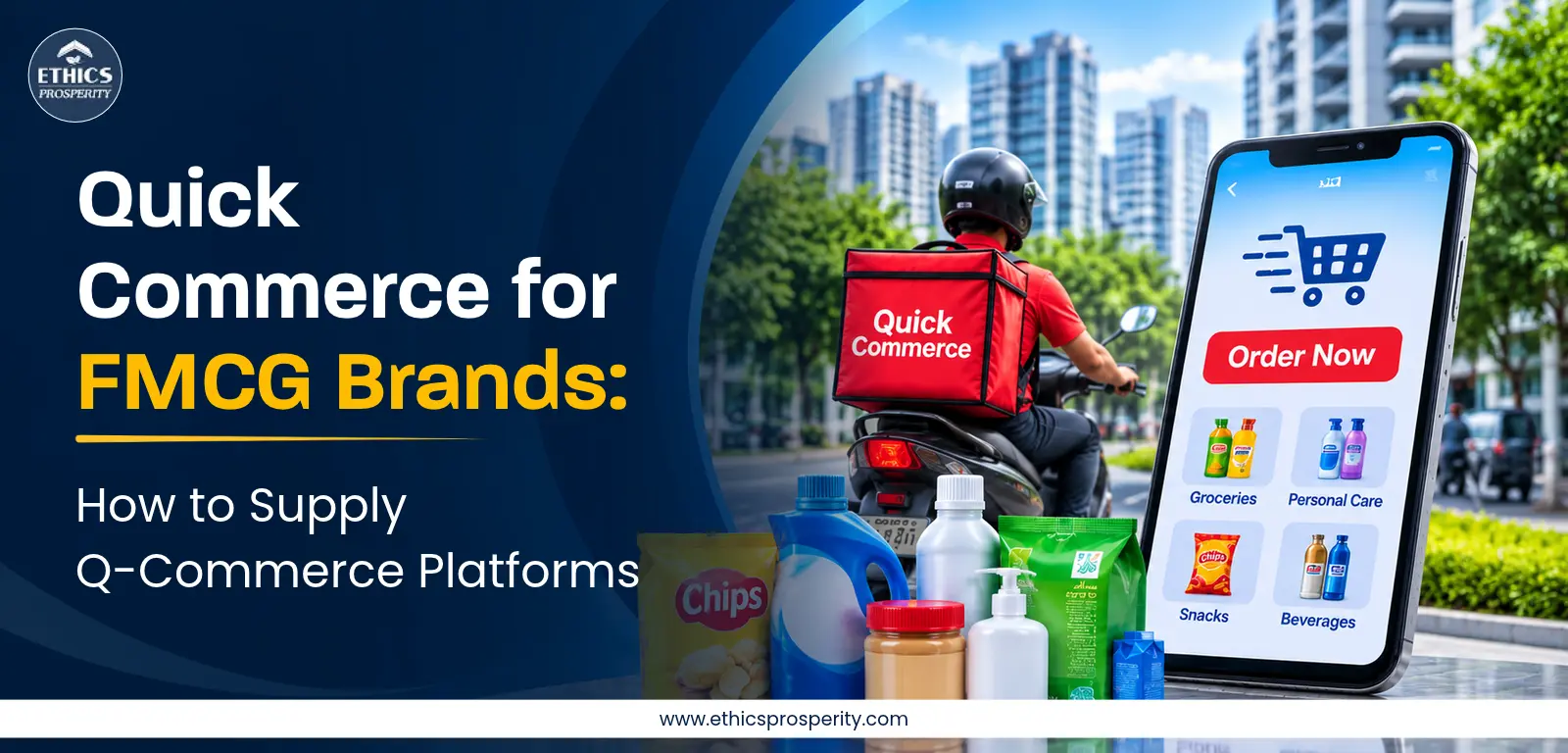
Quick Commerce for FMCG Brands: How to Supply Q-Commerce Platforms
Quick commerce has changed how consumers purchase everyday products. From packaged foods and beverages to personal care and household essentials, customers increasingly expect frequently used items to be available for delivery within a short time.
For FMCG brands, this creates an additional route to market. However, supplying quick commerce platforms requires more than listing products on an app. Brands must coordinate inventory, demand forecasting, distribution, replenishment and product availability across multiple local fulfilment points.
A product may have strong consumer demand across a city but still remain unavailable in a particular neighbourhood if stock is not positioned correctly. This makes operational planning essential.
A successful Quick Commerce for FMCG Brands strategy connects platform requirements with a reliable distribution network, allowing brands to improve availability while controlling inventory and fulfilment costs.
What Is Quick Commerce and How Does Its Supply Chain Work?
Quick commerce, or Q-commerce, is a retail fulfilment model designed to deliver products to customers within a short time, often through locally positioned inventory and technology-enabled order processing.
Unlike conventional online retail, which may fulfil orders from a central warehouse or regional distribution centre, quick commerce commonly uses a network of small local fulfilment facilities. These facilities are positioned close to customer demand and hold a selected assortment of fast-moving products.
The operating process generally follows this sequence:
-
Demand identification: Platforms analyse customer orders, search activity, location-level demand and product availability.
-
Inventory planning: Required SKUs and stock quantities are determined for individual fulfilment locations.
-
Brand or distributor replenishment: Products move from the brand's warehouse, distributor or supply point to the platform's facilities.
-
Order processing: When a customer places an order, the local facility picks and packs the products.
-
Last-mile delivery: A delivery partner transports the order to the customer.
These local fulfilment facilities are commonly known as dark stores. Their limited space makes assortment selection, stock accuracy and replenishment frequency particularly important.
The model also changes the role of upstream logistics. Brands must plan not only how much stock to send to a city, but also where and when that inventory should be delivered within the city.
Why Quick Commerce Is Important for FMCG Brands
Quick commerce gives FMCG brands access to consumers who prioritise convenience, immediate availability and smaller, frequent purchases. It can complement general trade, modern trade and traditional e-commerce rather than necessarily replacing them.
The channel is becoming relevant across categories such as packaged foods, beverages, snacks, personal care, home care and selected health and wellness products. The opportunity is not identical for every SKU: products with repeat demand, manageable storage requirements and suitable margins may be better candidates than slow-moving or bulky products.
The distinction in Quick Commerce vs e-commerce is important for brand planning. Traditional e-commerce can support a broader catalogue and fulfilment from larger facilities, whereas quick commerce generally depends on local stock availability, a narrower assortment and faster replenishment.
For brands, the potential business benefits include:
-
Greater product accessibility: Products can be made available closer to customers.
-
Additional sales occasions: Consumers can purchase items when an immediate need arises.
-
Local demand insights: Order-level data can help identify differences in product preferences between areas.
-
Assortment testing: Brands can assess the performance of selected pack sizes, variants and new products.
-
Channel diversification: Quick commerce can add another sales channel to an existing distribution strategy.
However, additional sales do not automatically mean higher profitability. Platform commissions, promotional spending, fulfilment costs, trade margins and replenishment expenses must be considered before scaling.
How Can FMCG Brands Supply Quick Commerce Platforms?
Supplying a Q-commerce platform requires coordination between the brand, platform procurement team, distributors, logistics partners and fulfilment operations. A structured onboarding and supply plan helps reduce stockouts, excess inventory and delivery failures.
Understand Platform Onboarding and Commercial Requirements
The first step is to understand the platform's vendor onboarding process. Requirements may include business and tax documentation, product information, barcodes, packaging details, commercial terms, serviceable locations and quality-related documentation.
Brands should clarify:
-
Who raises purchase orders and who receives the inventory?
-
Which facilities or locations will be supplied?
-
What are the delivery appointments and receiving procedures?
-
What are the agreed fill rates and service-level expectations?
-
How are damages, shortages, returns and invoice discrepancies handled?
-
Who is responsible for inventory visibility and reconciliation?
These details should be agreed upon before regular dispatches begin. A clear responsibility matrix prevents avoidable disputes between the brand, distributor and platform.
Select the Right Products and Assortment
Not every product in a brand's portfolio needs to be introduced across every location. The initial assortment should be based on customer demand, purchase frequency, pack size, selling price, product shelf life and contribution margin.
For example, a packaged food brand may prioritise frequently purchased snack packs and everyday staples in high-demand locations. Larger family packs or less frequently purchased variants may require a different stocking decision.
Brands should review sales velocity and availability by SKU and location rather than relying only on total city-level sales.
Plan Inventory and Replenishment
Quick commerce requires shorter planning cycles than many conventional retail channels. Demand can vary significantly between neighbourhoods, and a product that sells consistently in one catchment may move slowly in another.
Brands should establish replenishment plans using:
-
Historical sales and recent order trends.
-
Location-wise SKU movement.
-
Promotional calendars and seasonal demand.
-
Supplier and manufacturing lead times.
-
Minimum order quantities and delivery schedules.
-
Safety stock based on demand and supply variability.
A practical approach is to begin with a limited group of locations, monitor sales and stock movement, and then expand the assortment or service area based on actual performance.
Build a Reliable Distribution Network
The brand's upstream network must be capable of replenishing multiple local facilities without creating unnecessary transport costs. Depending on volume and geography, supply may flow through a central distribution centre, regional warehouse, city-level stock point or authorised distributor.
A well-designed FMCG Supply Chain should balance inventory availability with transport frequency, vehicle utilisation and stock holding costs. For businesses operating across several cities, location-wise replenishment plans are particularly important.
Key Supply Chain Requirements for Q-Commerce Platforms
Quick commerce platforms expect dependable product availability and consistent inbound supply. Brands should build their operating model around the following requirements.
1. High order fulfilment accuracy: Product codes, quantities, packaging and invoices should match the purchase order and receiving requirements.
2. Reliable replenishment: Dispatch schedules should reflect actual consumption, agreed delivery windows and stock cover at each location.
3. Accurate inventory records: Stock at the brand warehouse, distributor and platform facility should be reconciled regularly.
4. Product and packaging readiness: Products should have scannable barcodes, clear labelling, suitable packaging and sufficient remaining shelf life as required by the platform.
5. Cost visibility: Brands should evaluate the full cost of serving the channel, including storage, transportation, handling, trade terms, returns and promotional expenditure.
6. Responsive coordination: Sales, planning, warehouse and logistics teams should share information about purchase orders, dispatches, shortages and delivery exceptions.
The operating requirements should be supported by disciplined Warehouse Management at the brand's own facilities. Picking accuracy, stock rotation, dispatch documentation and vehicle planning all influence the reliability of platform replenishment.
Common Challenges FMCG Brands Face in Quick Commerce
The fast-moving nature of the channel creates several operational and commercial challenges.
-
Demand variability: Sales may differ sharply between locations, making city-level forecasting insufficient.
-
Stockouts: Delayed purchase-order fulfilment or inaccurate stock records can reduce product availability.
-
Excess inventory: Sending too much stock to a slow-moving location increases holding costs and expiry risk.
-
Limited facility space: Local fulfilment facilities cannot accommodate every SKU or large quantities of slow-moving products.
-
High replenishment frequency: Smaller and more frequent deliveries can increase transport and handling costs.
-
Margin pressure: Platform commissions, discounts and promotional expenses can reduce contribution margins.
These are common FMCG supply chain Challenges that need to be addressed through location-level planning and regular performance reviews.
Brands should track metrics such as fill rate, on-time delivery, stockout frequency, inventory days, order accuracy, returns and contribution per SKU. These measures help identify whether the channel is generating sustainable business value rather than simply higher order volumes.
How Technology Improves Quick Commerce Supply Chain Efficiency
Technology helps FMCG brands manage the speed and complexity of Q-commerce operations. It is most useful when it connects sales information with inventory, warehouse and transport decisions.
A suitable system can support:
-
Demand forecasting at SKU and location level.
-
Inventory visibility across distribution centres and local facilities.
-
Automated replenishment alerts.
-
Barcode-based receiving and dispatch.
-
Purchase-order and invoice reconciliation.
-
Transport tracking and delivery confirmation.
-
Reports on stockouts, ageing inventory and service performance.
For example, if a product begins selling faster in a particular area, sales and inventory data can help the planning team identify the requirement for additional replenishment. The team can then check available stock, dispatch capacity and delivery schedules before a shortage develops.
Technology should also support collaboration between brand teams, distributors and logistics providers. Accurate data and clear exception reporting are more valuable than dashboards that do not lead to timely operational action.
Conclusion
Quick commerce offers FMCG brands an additional way to reach consumers, but long-term success depends on more than platform presence or promotional visibility. Brands need a disciplined approach to assortment selection, local demand planning, inventory control, replenishment and distribution costs.
As the channel expands, businesses should review their network capacity and fulfilment processes regularly. A dependable Warehousing and Distribution Service can help brands coordinate inventory movement, improve replenishment discipline and support consistent product availability. With the right operational planning and logistics support, Ethics Prosperity can be considered by businesses evaluating their wider supply chain requirements.